 Skip to content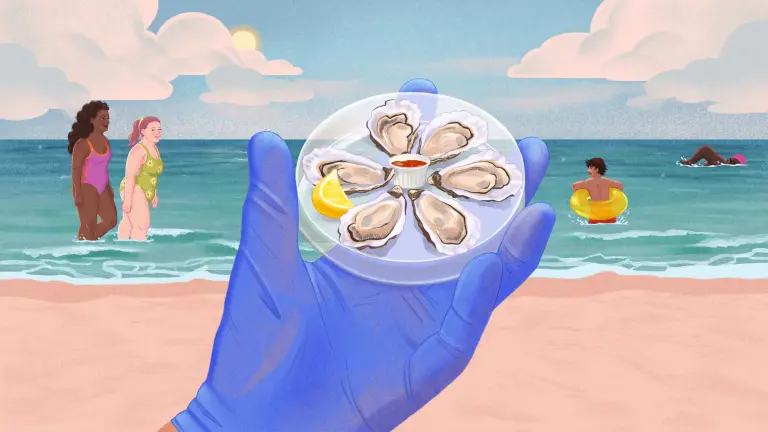
Bailey Magers and Sunil Kumar cut strange figures on Pensacola Beach. Bags of disinfectant solution surrounded them on the white sand; their gloved hands juggled test tubes while layers of rubber and plastic shielded their skin from the elements. As the two organized their seawater samples on the popular Florida shoreline last August, an older woman wearing a swimsuit walked over to ask what they were doing.
“We’re just actively monitoring water quality,” they told her, but she pressed on
“Are you looking for that flesh-eating bacteria?”
“We’re looking into it,” they replied, hoping not to frighten her. The woman turned back toward the ocean, her curiosity satisfied. As she walked away, Kumar noticed that she had scrapes and bruises on her body. A few minutes later, he watched her step into the waves. He shook off a chill and returned to the task at hand.
Magers and Kumar study a bacteria called Vibrio, part of a lineage of ancient marine species that likely emerged sometime around the Paleozoic Era. Enormous, shallow seas flooded the massive, interconnected supercontinents that constituted the Earth’s landmass at the time, and complex marine ecosystems developed that thrived in these temperate, freshly-formed bodies of water. Researchers think there are more than 70 Vibrio species in the environment today, hundreds of millions of years later. The organisms float in warm, brackish water, attaching themselves to plankton and algae and accumulating in prolific water-filtering species like clams and oysters.